

For Boys & Girls Clubs, YMCAs, schools, parks and recreation departments, and other youth-serving organizations, a major new funding conversation is beginning across the country.
In August 2026, Meta reached a landmark multistate settlement resolving claims related to the impact of Facebook and Instagram on children and teenagers. The agreement is worth more than $17 billion and includes both financial payments to participating states and significant changes to how Meta’s platforms operate for young users.
What may be even more important for youth-serving organizations is how states are beginning to describe the purpose of those funds.
Texas has specifically identified youth mental-health services, digital-literacy initiatives, after-school programs, crisis resources, and grants for schools as remediation efforts. Massachusetts has identified youth mental-health services, after-school, summer and outdoor programming, digital wellness and literacy, and phone-free-school initiatives. Delaware has said a substantial portion of its payments will support teen health and safety, including after-school programs, educational grants, crisis intervention, and services for at-risk youth. Connecticut has similarly identified mental-health services, after-school and summer programming, and phone-free-school initiatives.
That creates an important question:
What does helping young people recover from the negative effects of excessive and unhealthy social-media use actually look like in the real world?
One answer may be remarkably simple.
Give kids more opportunities to move, play, interact, compete, laugh, build relationships, and experience something engaging away from passive scrolling.
That is where exergaming may have a unique role to play.
The Goal Isn’t Simply Fewer Screens. It’s Better Experiences.
Discussions surrounding social-media harm can easily turn into a debate about eliminating technology altogether.
But technology itself is not necessarily the enemy.
The larger concern is what young people are doing with technology, how much time they spend using it, and whether that technology encourages passive consumption and isolation or leads to healthier behavior.
Exergaming changes that equation.
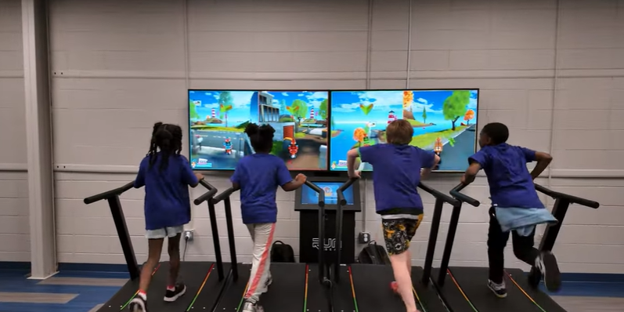
Instead of sitting and scrolling through a social-media feed, a participant might be pedaling a bike, reacting to lights, running, jumping, reaching, throwing, dancing, competing with a friend, or working together toward a shared goal.
The screen or technology becomes the trigger for physical activity rather than the destination.
That distinction could be extremely important as organizations begin developing programs around social-media remediation, youth wellness, after-school engagement, and healthier alternatives to passive screen use.
The message is not necessarily “no technology.”
It can be:
Less passive screen time. More active play.
Why Exergaming Can Fit the Intent Behind Youth Wellness Funding
Fund IRL, a national coalition advocating for youth-centered use of social-media litigation proceeds, has encouraged states to invest settlement resources in the programs and environments where young people can build relationships and thrive in real life.
Those recommendations include after-school and summer programs, sports, mentoring, arts, outdoor experiences, youth development, mental-health support, and other opportunities for young people to connect and belong. Fund IRL’s guidance also emphasizes measurable approaches that prevent, mitigate, or remediate social-media-related harms while strengthening youth resilience and real-world connection.
Exergaming can complement many of those objectives.
It provides a bridge between something many young people already enjoy—gaming and technology—and the physical, recreational, and social experiences youth organizations want them to experience more often.
Recent research also supports exergaming as a legitimate physical-activity tool rather than simply another form of sedentary gaming. A systematic review and meta-analysis of randomized trials found exergame-based interventions were associated with increases in physical activity, moderate-to-vigorous physical activity, and step counts. A separate review examining exergaming with school-age children found potential benefits involving motor skills, participation, cognitive functions, psychological well-being, self-confidence, and physical activity.
Exergaming should not replace traditional sports, outdoor recreation, physical education, or face-to-face youth programming.
It can provide another doorway into those healthy behaviors, particularly for young people who may not immediately connect with traditional fitness or organized sports.
At existing Boys & Girls Club and YMCA installations, interactive fitness environments are already being used to encourage movement, friendly competition, cooperative play, communication, and participation among young people with different interests and abilities.
Don’t Write a Grant for Equipment. Write a Grant for an Outcome.
This may be one of the most important considerations for organizations pursuing settlement-related funding.
A request that simply says:
“We would like funding to purchase interactive fitness equipment.”
may miss the larger opportunity.
Instead, the equipment should support a clearly defined youth-development program.
A strong funding request could be structured around six elements:
1. Define the problem being addressed. Explain how excessive passive screen use and social-media engagement can displace opportunities for physical activity, recreation, face-to-face interaction, and healthy after-school participation.
2. Present an Active Digital Wellness solution. Describe a structured program that redirects young people’s interest in gaming and technology toward movement, fitness, recreation, teamwork, and supervised social interaction.
3. Identify who will participate and how the program will operate. Define the age groups served, number of youth expected to participate, frequency of programming, after-school or summer schedule, staffing, and how the space will be incorporated into existing programming.
4. Connect the program to measurable outcomes. Rather than promising broad health outcomes that cannot easily be demonstrated, organizations can track participation, program attendance, minutes of active engagement, repeat participation, youth satisfaction, utilization rates, and other achievable measurements.
5. Build a complete program budget. Interactive fitness equipment can be one component alongside room preparation, staff education, installation, program development, evaluation, and other eligible costs. Funding rules will vary, so applicants should always confirm which expenses are allowed by the specific grant.
6. Explain the long-term value. Show how the investment can continue serving young people beyond the initial grant period through existing after-school, summer, recreation, physical-education, wellness, or teen programming.
This approach changes the conversation from “buying fitness technology” to “investing in a youth wellness and engagement program.”
That is a much stronger story.
Sample Grant Language: Turning Passive Screen Time Into Active Engagement
An organization might describe its proposed program this way:
The proposed Active Digital Wellness Program will provide youth with structured, supervised opportunities to redirect their interest in gaming and technology toward physical activity, recreation, teamwork, and face-to-face social engagement. Interactive fitness technology will require participants to move as part of the experience through activities involving cycling, reaching, reacting, running, dancing, throwing, and other forms of active play.
Rather than introducing additional passive screen exposure, the program is designed to transform the role technology plays in young people’s lives. Technology becomes a catalyst for movement and real-world participation while creating opportunities for youth to interact with peers, challenge themselves, build confidence, and develop healthier recreational habits.
The program will be incorporated into existing after-school and youth-development programming and will provide an additional option for participants who may be less engaged by traditional sports or fitness activities.
That type of language directly connects the proposed investment to the larger reason these funding conversations are happening in the first place.
Build the Request Around Physical, Mental and Social Well-Being
Another opportunity is to avoid putting the entire proposal into a single category such as “fitness.”
Exergaming can contribute to a broader youth-development strategy.
Physically, programs can create additional opportunities for movement and provide an engaging alternative to sedentary recreation.
Socially, multiplayer games, team challenges, shared spaces, score-based activities, and group participation can create natural opportunities for communication and face-to-face interaction.
Emotionally, recreational programs can provide a positive environment where young people can experience success, challenge themselves, interact with trusted adults and peers, and simply have fun.
The strongest proposals will not claim that an Exergame room can independently solve youth mental-health concerns or social-media addiction.
Instead, exergaming can be presented as one part of a larger ecosystem of positive youth experiences—including mentors, recreation, sports, outdoor activities, wellness education, counseling resources, family engagement, and other community supports.
That is also consistent with the broader approach being advocated by organizations such as Fund IRL: invest in the people, programs, and places that give young people meaningful opportunities to connect and thrive in real life.
Creating a Space Kids Actually Want to Use
A grant can have the right intentions and still struggle if young people do not participate.
Engagement matters.
That is one of the reasons gaming and gamification can be so valuable.
Many young people already understand scores, challenges, levels, instant feedback, competition, and trying to beat a personal best. Exergaming uses those familiar concepts to encourage something completely different from passive scrolling: physical participation.
For a child who loves basketball, traditional recreation may already work.
For another child who does not consider themselves an athlete, an interactive wall, active gaming challenge, dance experience, reaction game, or gaming-connected bike may provide the invitation they need to participate.
The objective is not to redefine every child’s relationship with technology.
It is to create more compelling alternatives.
How Exergame Can Help Organizations Develop a Funding Concept
For organizations interested in pursuing settlement-related grants or other youth-wellness funding, Exergame can help develop the concept well before an application is submitted.
That process can begin by identifying the organization’s goals, population, available space, program schedule, anticipated participation, and funding range.
From there, Exergame can help develop a recommended interactive fitness environment, room layout, equipment package, budget, product descriptions, program concepts, presentation materials, and language explaining how the proposed space supports movement, recreation, engagement, teamwork, and youth wellness.
For larger projects, that may also include visual room concepts and layouts that help administrators, boards, donors, grant reviewers, or community partners understand what the proposed program will actually look like.
We can also help organizations think beyond the equipment itself.
How many young people can the program serve?
How could stations rotate during an after-school program?
Could the room support summer programming?
Can activities be used for individual challenges and group programming?
How could participation be measured?
What outcomes could realistically be reported back to a funder?
Those are the questions that can turn a collection of products into a more complete program proposal.
Exergame cannot determine whether a particular settlement fund or grant will approve a project, and funding rules will differ by state and program. Some funding opportunities may also place restrictions on equipment purchases or technology-based programming.
But when the opportunity fits, we can help organizations clearly communicate what they want to accomplish, how the space can operate, and why interactive fitness can support the outcomes the funding is intended to create.
Start Planning Before the Grant Opens
Organizations do not necessarily need to wait until a formal grant application appears before beginning this process.
In many states, decisions about settlement funding are still developing. Fund IRL is specifically encouraging youth organizations and community leaders to become involved early as states determine how resources will be distributed.
That makes now a good time for Boys & Girls Clubs, YMCAs, schools, park districts, municipalities, and other nonprofit organizations to begin identifying projects they would be prepared to implement.
Determine the population you want to serve.
Identify the space.
Establish the need.
Define the program.
Estimate the budget.
Decide what success would look like.
Then, when the right funding opportunity becomes available, much of the foundational work has already been completed.
Turning Accountability Into Opportunity
The social-media settlement represents something bigger than a financial payment.
It creates an opportunity to rethink what communities can provide young people when we ask them to spend less time passively consuming content online.
Simply telling kids to put their phones down is only part of the answer.
We also have to give them something worth getting up for.
A game with a friend.
A challenge they want to beat.
A place where they belong.
A reason to move.
An environment where technology leads to interaction instead of isolation.
For Boys & Girls Clubs, YMCAs, schools, recreation programs, and youth-serving nonprofits, social-media settlement funding could help create more of those opportunities.
And Exergame is ready to help organizations begin designing what those opportunities can look like.
Interested in developing an Active Digital Wellness or interactive fitness concept for an upcoming funding opportunity? Contact Exergame to discuss your space, program goals, room design, equipment options, budget, and presentation needs.